
Rationing ended in Hanoi in 1986, but the choreography outlived it: pay first, take a ticket, carry your own bowl, sit at a table you share with strangers. Four decades on, a small number of the city's kitchens, beer counters and coffee corridors still work that way. Some were built in the subsidy years and never saw a reason to change. Others have rebuilt it deliberately, down to the enamel plates. What follows is a route through both, arranged around the hours these places actually keep, because several of them shut in the middle of the day and one is open for two and a half hours.
What bao cap left behind
Bao cap, literally "state subsidy", is how Hanoi refers to the planned-economy decades that ran from the mid-1950s in the north until the Doi Moi reforms of 1986 began dismantling them. Households held tem phieu, coupon books for rice, meat, fish sauce, cloth and sugar, and queued at mau dich state trading shops that opened when stock arrived and closed when it ran out. Most of the city lived in khu tap the, collective blocks built around a shared courtyard, a shared tap and a shared stairwell, and the generation that grew up in them is now the generation running these businesses or sitting in them at four in the afternoon.
The scarcity is still legible on the plate. Cassava and maize padded out the rice ration. Lard did the work that oil does now. Condensed milk was unobtainable for most of the period, so Hanoi whipped egg yolk into coffee instead and invented a drink the city now exports. None of that is costume, which is why this theme survives contact with a good appetite: the dishes are solutions to a specific problem, and the places below are either the originals or careful reconstructions of them.
The anchor dinner on Tran Vu
Cửa Hàng Ăn Uống Mậu Dịch Số 37 (Tran Vu, on the Truc Bach side of Ba Dinh) is the one room that does the whole subject at once, and it holds a MICHELIN Bib Gourmand for doing it with actual cooking rather than props. The rice comes padded with cassava the way a ration was stretched, the fish is stewed down in soy, the greens are fried in lard, and the service is period re-enactment rather than pastiche: staff in era uniform, coupons on the wall, tin and enamel on the table.
One piece of logistics matters more than anything on the menu. It has moved from its original 37 Nam Trang address, so send your driver to Tran Vu. The old number is still in circulation online and it will cost you twenty minutes of circling.
The core business is shared family-style tables, so a couple will eat alongside other diners and should expect to. The room is small and fills with tour groups at lunch, which flattens the atmosphere; dinner is the better booking. Reserve ahead for six or more. Reckon on 150,000 to 250,000 VND a head, with around 400,000 VND feeding four if you order plainly and let the kitchen steer you.
Standing in the line at Bát Đàn
Phở Gia Truyền Bát Đàn (Bat Dan street, Old Quarter) is the closest thing in Hanoi to a living ration line, and it is not trying to be. You queue on the pavement, pay at the front, take your ticket, and carry your own bowl to whatever gap you can find at a shared table. That is the exact sequence a mau dich canteen imposed, preserved because it is still the fastest way to move several hundred people through a narrow shopfront. The broth is clean and beef-forward, the beef itself sliced rare or well-done to order, and a bowl is 50,000 to 60,000 VND. It earned a 2026 Bib Gourmand.
There are no reservations and nobody will hold a table. A group of six arrives as six individuals and will be split up, so agree in advance that you are eating separately and comparing notes afterwards. The hours catch people out: 6am to 10am, then 6pm to 8.30pm, and nothing in between. A midday visit gets you a shuttered front and a long walk back.
Cơm nhà without the set dressing
If the themed rooms start to feel like a performance, Xới Cơm is the corrective, a few tables in an old residential block serving northern com nha, the home cooking a subsidy-era household produced when it ate well. The menu changes daily, which is the whole proposition: you eat what the market gave up that morning, in the order a family would, with rice and a soup doing the structural work and the protein used sparingly. It has held a Bib Gourmand four years running, from 2023 through 2026, a remarkable run for a place this domestic.
Small groups only, four to six, and call ahead rather than turning up hopefully. 80,000 to 150,000 VND a head.
A ticket for your beer, and only until half six
Bia Hơi Các Cụ, the beer counter at the Ba Dinh Sports Centre, is the most literal survival of bao cap anywhere in the city. It is a 1980s state-cooperative counter where you buy a ticket and queue for your glass, and the queue still contains retired generals, neighbourhood pensioners and whoever has finished work early. Nothing has been restored or themed. It simply never stopped.
A glass is 12,000 to 14,000 VND, a jug 60,000 to 70,000 VND, which is the cheapest hour in this article by a wide margin. Treat it as a precise appointment rather than a drop-in: it opens 16:00 to 18:30 and closes on public holidays. Come as two to four people. The space is tiny, the atmosphere is informal and genuinely welcoming to outsiders, and nobody runs a tab, so everyone queues for their own, including you, every round.
Two state restaurants still on the water
Nhà Hàng Bánh Tôm Hồ Tây (on the causeway between West Lake and Truc Bach) is the direct descendant of the state-run banh tom stand that worked this strip of water through the 1970s and 80s, frying shrimp fritters in batter for people walking home. It is now a large operation, with capacity running to roughly 1,000 covers across the indoor rooms and the terrace, and it handles banquets as a matter of routine. That makes it the obvious answer to the hardest problem with this theme, which is where to put a party of twelve without abandoning the subject. The fritters are still the order. Open 09:00 to 21:00, 100,000 to 200,000 VND a head.
Thủy Tạ (northwest corner of Hoan Kiem lake) was founded in May 1958 and remains the only building standing on the lake itself. Under rationing it sold the state-enterprise ice cream Hanoians queued for, and since Kem Trang Tien gave up 35 Trang Tien in September 2026 it is the surviving half of that pair, which gives the queue at the hatch a weight it did not have a year ago. The hatch is stand-and-eat, 30,000 to 60,000 VND, and the correct way to use it. The restaurant upstairs is a different proposition at 200,000 to 400,000 VND a head; book it for eight or more, and go for the water and the windows rather than expecting the kitchen to carry the evening.
Coffee that was invented around a shortage
Café Giảng (Nguyen Huu Huan, Old Quarter) is where egg coffee was worked out in 1946, for the unglamorous reason that milk could not be had: yolk, sugar and condensed-milk technique whipped into a foam that sits on strong Vietnamese coffee and insulates it. That makes it the founding dish of the city's make-do tradition, and it is still run by the founding family. The corridor and back room are tight and frequently full, there are no bookings, and the only sane approach is to arrive as two or three and accept a stool. Open 07:00 to 22:00, 25,000 to 40,000 VND.
Café Lâm (also in the Old Quarter, a short walk from Giảng) has been open since 1952 and is an accidental gallery. The paintings on the walls, Bui Xuan Phai among them, are what broke artists handed over in lieu of money for their coffee, which means the barter economy of the period is hanging in plain sight above your head. Walk-in only; four to six people can spread across the room, but it is too small for a real party. 25,000 to 50,000 VND.
Cafe Đinh (up a stairwell off Dinh Tien Hoang, above the lake) was opened in 1987 by Mrs Bich, daughter of Café Giảng's founder, which makes it the subsidy-decade sibling of the egg-coffee dynasty rather than an imitation of it. The climb is steep and unpromising, and the shabby stairwell is the attraction rather than something to apologise for. Balcony seats over the water are contested and you will probably not get one, so send pairs and small groups. No bookings, 25,000 to 45,000 VND.
Cà Phê Nhân (39D Hàng Hành, off the lane behind Hoan Kiem lake) dates to 1946 and is one of the four pillars of Hanoi coffee, with Nhi, Di and Giang. It kept roasting through the planned-economy years, which is the detail that earns it a place here, and it now also does bun ca at lunch if you want the stop to be a meal. Upstairs takes four to eight comfortably; evenings are busiest and most local. Open 07:00 to 22:00, 35,000 to 150,000 VND depending on whether you are drinking or buying beans.
The canteens rebuilt on purpose
Căng Tin 109 is a deliberate reconstruction of a collective canteen, built inside a real state dormitory block, with the childhood snacks of the period laid out on the counter. It is the most convincing canteen set-piece in the city for anyone who wants the room rather than just the drink: the light, the tiling, the noticeboard logic of it. Casual and group-tolerant, nobody takes bookings, and there is a second branch off Hoang Cau if the first is full. 20,000 to 40,000 VND.
Quán Hè is an actual 1980s khu tap the flat and its courtyard, turned into a cafe, so it carries the architecture this article is about instead of referencing it. The courtyard is huge and open-air, which makes it the best group option among the retro cafes, and it stays open until 03:00 on Friday and Saturday. The house rule is to keep the noise down, because neighbours still live overhead and this is their stairwell. 30,000 to 50,000 VND.
Cafe Xí Nghiệp was one of the first bao cap cafes Hanoi opened and is still the most committed to the state-enterprise conceit its name claims, from the paperwork on the walls to the furniture. It has room for eight to ten across its floors and takes walk-ins. The catch is Ha Dong, a long ride from the Old Quarter, so pitch it to yourself as a deliberate detour rather than a stop on a loop. Open 07:00 to 22:30, 20,000 to 55,000 VND.
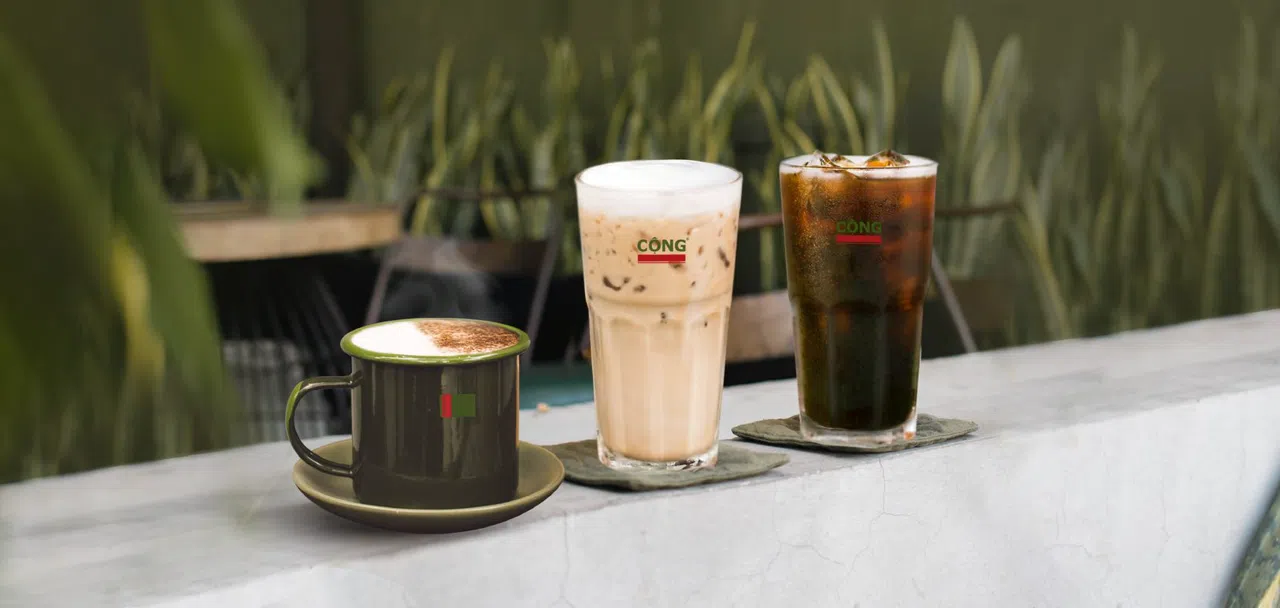
Cộng Cà Phê is the brand that turned all of this into an aesthetic, growing from a single 2007 shop on Trieu Viet Vuong into a national chain with around 26 Hanoi branches, most of them on several floors. Take it as an operator rather than a destination: there is no door policy and no booking, it is easy with a group, and the Nha Tho or Dien Bien Phu branches are the ones to use. 35,000 to 75,000 VND a drink.
The peacock blanket that explains the look
Chăn Con Công — Vintage Store is named after the chan con cong peacock blanket, the single household object every Hanoian of that generation can picture without being asked. It is the non-food stop that makes sense of everything else: the palette, the enamelware, the clothing cuts the cafes are quoting. Clothing runs 150,000 to 600,000 VND, with blankets and textiles higher. The shop is small, so browse in twos and threes; several sister branches nearby absorb the overflow. Open 09:00 to 22:00 daily.
One day that fits the opening hours
The hours dictate the shape. Be in the Bát Đàn queue by 06:30, then walk ten minutes to Café Giảng or Café Lâm while the Old Quarter is still quiet. Mid-morning is for Cà Phê Nhân or the climb to Cafe Đinh. Take the Thủy Tạ hatch around midday when nothing serious is open, then spend the early afternoon on Chăn Con Công and Căng Tin 109, which are at their best empty. Be at Bia Hơi Các Cụ at 16:00 sharp, because it is gone by 18:30, and that drops you within range of Mậu Dịch Số 37 on Tran Vu for dinner, or Nhà Hàng Bánh Tôm Hồ Tây if there are more than eight of you. Quán Hè takes the late end on a Friday or Saturday.
Staying in Hoan Kiem puts the coffee houses and the pho queue on foot; staying towards Ba Dinh or Truc Bach favours the beer counter and the two lakeside restaurants. Compare both on the Hanoi hotel search. For everything outside this theme, the Hanoi guide covers the rest of the city.
Practical notes
Carry small notes. The beer counter, the ice-cream hatch, the pho queue and most of the coffee houses are cash operations, and nobody at a ticket window wants to break a 500,000 VND note at 16:05.
The Old Quarter cluster (Bát Đàn, Giảng, Lâm, Đinh, Nhân) is all walkable within fifteen minutes. Ride-hailing motorbikes are the practical way to reach Tran Vu, the West Lake causeway and Ba Dinh, and cost very little over those distances. For Cafe Xí Nghiệp, the Cat Linh to Yen Nghia metro line runs out to Ha Dong and is a more predictable half-hour than road traffic at rush hour.
Three places are appointments rather than options: Bát Đàn (6am to 10am, 6pm to 8.30pm), Bia Hơi Các Cụ (16:00 to 18:30, closed public holidays) and the Mậu Dịch Số 37 dinner service if you are a group. Build the day outward from those. Avoid lunchtime at Mậu Dịch Số 37 unless you are content sharing the room with coach parties.
A full day of coffee, ice cream, a pho breakfast, beer and the vintage shop sits around 300,000 to 500,000 VND a head. Add 150,000 to 250,000 VND for dinner at Mậu Dịch Số 37, or 100,000 to 200,000 VND at Bánh Tôm Hồ Tây, or 200,000 to 400,000 VND if you take the Thủy Tạ restaurant upstairs. The whole theme is, fittingly, one of the cheapest serious days out in the city.
The group hierarchy is worth being honest about. Bánh Tôm Hồ Tây and Quán Hè handle real numbers; Cộng Cà Phê, Căng Tin 109 and Cafe Xí Nghiệp take eight to ten; Mậu Dịch Số 37 and Thủy Tạ upstairs work at six to eight with a booking; Xới Cơm, Café Giảng, Café Lâm, Cafe Đinh and Bia Hơi Các Cụ are for pairs and fours, and treating them otherwise ruins them for everyone in the room.